TL;DR: AC is simple and useable, but it doesn't always feel like armour. Here are some alternatives.
This post is brought to you by two thoughts. The first is: What options do I have when picking an armour mechanic for a new system? Which systems have some cool ideas I can steal?
What if I want a Dark Souls-like system where you can pick from many, many suits of armour and each is different, but ideally without the difference being just ±1 point of defence?
The second is: Weapons tend to be more interesting than armour. Especially mechanically, especially in D&D derivatives and especially when talking about non-magical gear. It's hard to make different suits of armour feel distinct and varied when they only scale to bigger defence numbers and maybe their encumbrance changes from one type to another.
But you can have resistances and buffs and such on your armour!
True, but weapons have damage dice (and even d8 versus 2d4 is quite different), to-hit bonuses, crit ranges and multipliers, bleeding and poison and other special effects - and we're still not in the realm of enchantments. The mechanical side of combat procedures is simply more shifted towards weapons. On the one hand, there's nothing wrong with a simple defence mechanic that gets the work done. On the other hand, it would be nice if the choice of armour mattered more, mechanically, and I don't mean just the choice of leather versus plate.
Why should all armours in a game protect you the same way, anyway? What if we had several protections to choose from, to mix and match?
I will not provide you with such a cool new system, sorry. I only have a list of armour mechanics.
1. Hit protection
Known as Armor Class in D&D, but other RPGs will most likely call it Evasion or Dodging. Hit protection makes it harder to hit you rather than decreasing the damage taken.
I think that D&D's AC seems weird and unintuitive at first, but once you have accepted it as an abstraction, it works very well within its rule system. In the absolute majority of RPG systems, though, hit protection will be a separate evasion score, leaving armour with some other type of defence mechanic. It is actually rare not to see one of the defence mechanics below combined with some form of hit protection, as the defence dichotomy of "evade the hit or decrease the damage" is pretty fun and thus ubiquitous. Hit protection might be the most popular defence mechanic.
Hit protection tends to apply against all types of attacks and damage, but does not necessarily need to. Starfinder, for example, differentiates between an Energy AC and a Kinetic AC.
As it is an all-or-nothing defence, hit protection has to be scaled against the accuracy of enemies. There is no fun in combat if you or your foe are impossible to hit, though having a small chance to hit no matter how high the evasion is (criticals, basically) can help with that. But frankly, this applies to all mechanics - don't let your numbers scale out of hand.
2. Flat damage reduction
The most simple damage decreasing defence, just take [amount] less damage from attacks. It might only work against a certain type of damage (slashing, fire, magic), or be bypassed by something (silver, +1 weapons, lawful good attackers).
It's big weakness is, in my opinion, that it requires a very careful balancing of enemy damage output versus the amount of damage reduction. If it falls behind the average damage, it feels useless. The damage you didn't take might still add up over time, but that doesn't help you feel better when you shave off 2 points from a 23 damage hit. If it's too high (heavens forbid if it can stack), it just makes enemies flail against you impotently and removes danger from combat. Even worse, it can result in a situation like in higher-level Tunnels & Trolls, where you have high damage reduction but still relatively low hit points. The attacks also get more powerful, with big variance in the damage output, where your damage reduction negates the vast majority of attacks, but those that get through might very well one-shot you.
Which is not to say it's a bad mechanic. One just has to make sure to keep both the damage reduction and the damage outputs grounded, and maybe have some armour-piercing criticals. Flat damage reduction is simple and feels like a protective armour, making it a popular mechanic to combine with hit protection. So many games use this dichotomy that it's actually more rare to see a game using only flat damage reduction - Into the Odd comes to mind thanks to its unique take on combat with no to-hit roll.
Some CRPGs derive both hit protection and damage reduction from a single score; in NetHack and POWDER, for example, high AC eventually starts giving you some damage reduction in addition to the hit protection it offers normally (though in POWDER, it is random damage reduction rather than flat one).
3. Random damage reduction
An alternative damage reduction mechanic that works much better with stacking armour. When you take damage, cut it down by a random amount between a minimum and a maximum. No matter how high your armour is, some hits will deal real damage. Note that this can lead to the "rarely hits but one hit kills" effect mentioned above, so keep that in mind, and it will require extra rolling, so it might slow your combat down.
If you are willing to use digital rollers, then you can have a simple but effective system where you roll damage reduction from 0 to [armour value], but even if you only used physical dice, you can have a crappy d2 armour, basic d4 armour, excellent d8 armour, or a heavy 2d4 armour. As with other damage decreasing defences, adding a damage type/source limit (cold, ranged, inflicted by an animal) can spice it up.
Mörk Borg uses this type of defence, but it's much more common in CRPGs, given that you can easily generate random numbers with arbitrary min and max there. For example:
- Sil and Elona have dice-based damage reduction.
- DCSS and POWDER have "zero to armour value" damage reduction.
- IVAN reduces damage by a random amount between half and full armour value.
4. Damage division
A percentage decrease in damage taken. Usually half damage, though a one-third/quarter damage could also be reasonably easy to calculate on the fly for a TTRPG, while a CRPG can go wild with any percentage that strikes their fancy. As with other damage decreasing defences, it can be limited to a damage type/source - and it often is, representing elemental resistances. The big thing here is that this defence will be just as good no matter how much you scale the damage - you always take half damage, whether it's 10 or 10 000 damage hit. This can be good, as your armour will remain relevant, or bad, as you will still take damage from that 2-dmg-per-hit mook even in your sweet power armour.
One way to make a more consistent damage reducing defence is to combine damage division (so you are guaranteed a certain decrease in damage) with some low damage reduction (so you are protected from minor damage). Off the top of my head, City of the Damned combines damage division and flat damage reduction, Elona uses damage division and dice-based random damage reduction, while DCSS combines damage division and the "zero to armour value" random damage reduction.
5. Damage conversion
This type of defence depends on what kinds of damage the system uses.
- Example A: Lets say that a suit of plate decreases the severity of the damage taken, from aggravated to lethal to non-lethal, rather than decreasing the damage numbers.
- Example B: A power armour in a sci-fi game or an invulnerability power in a superhero setting might convert vehicle-scale damage that normally instakills a human to a person-scale damage.
- Example C: The resource targeted by the damage is changed, like a regeneration power that converts attribute damage to hit point damage, or a magic shield that converts hp damage to mana drain.
Overall, damage conversion doesn't decrease the amount of damage taken, but makes it less harmful or easier to deal with. I can't think of a system that uses it exclusively, you're much more likely to see it as a special effect or ability.
6. Damage threshold
Similar to flat damage reduction at a first glance, damage threshold negates any damage lower than (or equal to) the threshold. If the damage exceeds the threshold, though, you take it in full, no reduction. This accentuates the danger of big hits and the "rarely hits but one hit kills" effect, so make sure you like that and plan for it with your damage and hp values.
7. Damage cap
The damage one can take from a single hit is capped at some maximum value, normally either flat or percentage-based (eg. "You may not lose more than 50% of your maximum hp from a single attack."), though I wonder how well would a random damage cap would work. Anyway, this means that multiple small hits become more dangerous that a single big hit, an inversion of a damage threshold.
It might be interesting to differentiate two armour types by one offering a damage threshold while the other offers a damage cap, especially if the attackers can also specialize in either multiple attacks or one massive attack. Another possibly fun mechanic would be if there was no way to get an immunity to certain damage, but you could combine a high enough damage threshold and a low enough cap to fake it.
8. Ablative armour
Armour either directly adds to your hit points, or grants a secondary hit point pool. You only have to work out whether it's:
- Hardcore: The armour needs repairs afterwards and grants no protection until fixed.
- Temporary: The "armour" is not a real armour but temporary hp that doesn't come back once used up.
- Soak: A small hp pool that can soak a certain amount of damage each round, recharging completely at the start of each round.
- Abstract: The hit points are abstracted completely and you have a combined pool of flesh and armour hit points that both come back after combat.
The original Tunnels & Trolls had hardcore ablative armour rules where your armour offered an extra hit point pool, but once these were gone, your armour was broken and useless. This was supposedly an intentional design choice to give fighters a money sink, but was dropped in later editions in favour of flat damage reduction. Many games these days go the abstract route or have some abilities that provide temporary ablative armour, but for example Cogmind is designed around various robot parts serving as your hardcore ablative armour, where you need to replace destroyed pieces as you take hits.
I particularly like soak, as it plays out similarly to damage
reduction without making weak attacks inconsequential. Enough attacks
in a single round can still bring you down, even if you stack soak. It's also relatively easy to keep
track of, because you just reset one
number each round.
In any case, ablative armour is simple to use and works very well with stacking armour pieces, as it builds on the already existing hit point mechanic. Technically speaking, hit points themselves are a form of abstract ablative armour preventing your character's death, so I guess I was wrong that hit protection is the most popular defence mechanic - ablative armour is, given all the games that have some form of hit points.
9. Immunity
Completely negates damage of a certain type or source. Most often seen as an enchantment that grants affliction or elemental immunity, but could also be an immunity to non-magical weapons (whether from being intangible or invulnerable), normal missiles, summoned creatures, spells, etc. In a sci-fi game, this could be reflective armour that confers immunity to lasers, or Dune-style shields that prevent damage from firearms but don't stop slow-moving melee and thrown weapons. It could be interesting to see an immunity to all melee attacks.
Given that this type of defence completely shuts down a certain kind of threat, it requires some planning around in the rules and shouldn't be too easy to obtain or pile up multiple types of, lest the character becomes untouchable. On the other hand, immunities can lead to some fun strategies, especially with area attacks or environmental threats.
If you want to have an immunity-based defence, consider some further restrictions than just a damage type. I will discuss several types of limitations in just a paragraph or two.
10. No protection
Mostly relevant to one page RPGs and other
super-light systems, or systems that de-emphasise combat to oblivion -
there is nothing the defender can do to prevent a hit or reduce damage,
therefore armour is by necessity useless. Don't get me wrong, it can
work well if combat is the ultimate fail state, it just cannot result in
interesting armour mechanics, so I'm including it here only for
completeness' sake. If there are any armour mechanics at all, it is no
longer this, but one of the above types of defence.
See the Mosaic Strict version of these rules
for a TTRPG example of no protection combat, but it is much more common
in CRPGs, where combat can more easily be presented as a positioning
puzzle (like in HyperRogue or Hoplite). Bonus points if all creatures also die in a single hit - then we can't even object that hit points are a kind of defence.
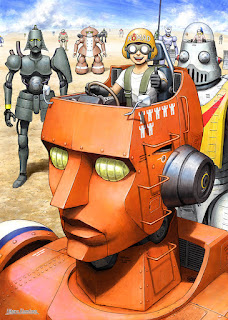 |
Could be especially relevant in a game
where you build your own humongous mecha
and can decide between multiple defensive systems.
By Hikaru Kanefusa.
|
Sometimes, you might wish to impose an extra limit on one of the defences from above, to curb some of the more powerful ones or the other way around, to let a defence be powerful without unbalancing combat. I think these three options cover most of the commonly seen mechanics:
A. Charges
You have a limited amount of "defence charges" and can decide when to spend them for your protection.
As an example, the shields shall be splintered rule lets you expend a charge (by destroying your shield) to either completely negate a weapon attack (immunity) or decrease damage taken by a die roll (random damage reduction), depending on which rule set are we talking about. In Broken Worlds, you can spend an armour charge to decrease damage taken by 3 (flat damage reduction). You could also spend a charge to reroll/get bonus to hit protection, or for half damage, for damage conversion, etc.
B. Saving throw
Unlike hit protection, which is a passive number your enemies roll against, you roll your saving throws when exposed to damage and apply a linked defence only if the roll succeeds. A saving throw is nearly always limited to a damage type/source (poison, breath attack, weapon attack) or a certain situation.
D&D already has such saves: Fortitude negates (saving throw + immunity), Reflex for half (saving throw + division), or fortification (saving throw + conversion). Mutants & Masterminds have a Toughness save against damage to prevent injury, while Mothership has an armour save for half damage. Encounter Critical also has an armour save, but it adds a little extra brilliance by making the normal save for half damage, but if you roll under half the armour save, you take no damage at all. While the new versions of TGGW use damage division, older versions had an armour save applied point by point; for example if you had Armour 60% and took 3 points of damage, each of those points had a separate 60% chance to be ignored.
C. Cooldown
Your defence is limited by a certain interval before coming back after you use it. There are basically three types:
- A set recharge rate of X rounds (or some other time unit). Probably best when the rate depends on some attribute or skill and thus can be lowered as you get better. Could also be used for a temporary defence buff, as long as the buff duration stays shorter than the recharge time.
- A randomized recharge rate, either useable every dX rounds, or with a chance to recharge on each turn. In D&D 4e, you might see some abilities with [recharge on ⚄, ⚅], but it could just as well be a 2-in-6 or 33% chance.
- An automatic defence that triggers every X rounds (or some such). For example, a flux field belt that deflects every third attack against you.
Note that a 33% chance to deflect every attack is an example of a saving
throw, not cooldown, but then again there will always be overlap in
these artificial categories I made up here.
Cooldowns are ubiquitous in video games, because they are a simple, effective and scaleable limit, plus the computer can keep track of them for you. In TTRPGs, it might be easier to use the "chance to recharge each turn"-type cooldown, but the automatic defence could prove quite interesting in gameplay, especially if paired with outright immunity. How would your combat decisions change if you knew that you cannot be harmed on every third turn?
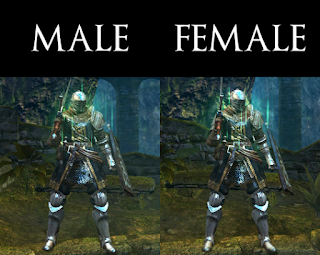 |
From Dark Souls.
|
And how could a selection of armour in this hypothetical system of multiple armour types look like? What about:
- Helmet or gorget can be cracked to reduce a critical hit to normal.
- Shield increases evasion and can be splintered to block a random amount of damage.
- Cloak and boots increase evasion.
- A fighter's skill of parrying gives a saving throw to negate weapon damage.
- A rogue's skill of dodge roll gives a saving throw to negate area damage.
- Padded jacket converts bludgeoning damage to non-lethal.
- Leather armour is ablative and needs to be repaired. Better hides give more bonus hp. Hunt for better hides.
- Mage armour is also ablative, but offers soak instead.
- Hauberk grants half slashing and piercing damage.
- Disc armour grants flat damage reduction.
- Battledress grants a damage threshold.
- Flagellant's tunic grants a damage cap.
- Ioun stone of protection intercepts every third attack against you.
- Pauldrons offer no protection at all, but they look really cool.